
first-contact cryptozoology
"While Mr Sporing was drawing on the Island he saw a most strange bird fly over his head; he describd it about as large as a kite and brown like one, his tail however was of so enormous a [length] that he at first took it for a flock of small birds flying after him. He who is a grave thinking man and is not at all given to telling wonderfull stories says he judg'd it to be at least yards in lengh."
- from the journals of Joseph Banks, entry dated 28 October 1769
- from the journals of Joseph Banks, entry dated 28 October 1769
thin sentinels as irregular stickforms.
their shadows trace uncertain linearities
into the tympanic fluttering of sea.
everything is salt-throbbed, the invisible
shipwrecks, the windfaded, dull harvest tones
of oxidation, corrosion. lichens, as though inspired,
restate similar tones, a mimicry across the register, mineral
to vegetable. a boat, cupped as an ear, roosts
above the waves, as the sea asks and asks.
we say : 'to keep going is hard, with no answer.'
but this language has both human and inhuman
listeners, it has fallen on rocks, over and over.
what arrogance to say : 'deaf as a stone'. a coast
of cochlear whorls and folds, such seismic traces
suggest instead a listening in
to instability, on this map the plates of geologic
shell hang, as a pond-skater rests. gulls emerge
from the dawn as messengers, stray signals
from a still burning black, empty and crackling.
they quieten as light flashes landscapes - fleeting,
mirrored - on the sea's meniscus, as the sky is hung
with hawks ascending a different knowledge of air,
below, that ancient heatmap bright with wing-
shivering morsels, a pattern scattered as daylit stars.
waiorua bay, 4.4.2012
waiorua bay, 4.4.2012


construction, for tide and phyllonites


date : 01.06.2012
location : rangatira
time : 5.00pm
notes : collaborative piece, with berlin based musician and sound artist johnny chang. we'd been talking a while about the notion of playing sounds back to environments. the composition johnny eventually sent me to transmit on kapiti was called 'construction', and it was ventriloquised to a flock of radios on the beach at rangatira, in a spot where the presence of phyllonite rock reveals the island's history of intense seismic activity. these were placed in small groups in the sand just before sundown, in the position oystercatchers might take while foraging, and infiltrated the elemental sounds of environment (the cries of sea birds, the crash of waves) with radio static, noise and the sounds of strings.
johnny writes of his composition of the piece : "just like the radio stations which you find in shortwave bands - the sounds were all recorded separately from one another. in fact, from time to time, i imagine them as complete and self-standing structures. or even, freestanding elements which lean upon each other. each element somewhat too fragile or obtuse to exist on its own. i imagined that your placement of this piece completes it. the elements in play are: Berlin-Kreuzberg open air sonic captures - threatening to burst out of the framework, whispy violin noise-tone combinations, viola low frequency resonances, zither tones gradually infected with extraneous noise radio static, in combination with pink noise, struggling to tune itself."

erased kapiti #1 : the memory of a territory


- 'The Vegetation of Kapiti Island', A. E. Esler, 1967
It is a great pity that Kapiti was allowed to be used for sheep farming. Those engaged in this business would have had trying times getting the wool away and could not have made much money... Kapiti should, in time, become an interesting botanical museum, where plants from all over New Zealand can be seen.
- 'Kapiti Bird Sancutary: a Natural History of the Island', A. S. & Amy Wilkinson, 1952
...I have come to realise that just as the modern is the most ancient, the archaic itself is a function of the new - it is thus first produced historically, as the archaic, and to that extent it is dialectical in character and not "pre-historical" but rather the exact opposite. For it is precisely nothing but the site of everything whose voices have fallen silent because of history...
- Theodor W. Adorno, in a letter to Walter Benjamin, 5 April 1934
The clearing and burning of Kapiti's old growth forests, in small part by Maori and then extensively and systematically in preparation for post-contact pastoral farming, occurred in stages. It is reckoned that the bush was mostly gone due to the farming of most of the island, and uncontrolled fires, before Kapiti was designated a nature reserve in the final decade of the 19th century. The highly managed nature of the island by various Government conservation caretakers since this time has ensured careful re-plantings progress toward forest regeneration and biodiversity, with donated trees and botanical memorials to shot-down airmen being part of this varied history. But this creation of a "tree museum" is not being enacted in a complete tabula rasa: a half dozen or so true Tāne Mahuta survive in the deep valleys, along streams and on mossy damp ridges, where the fires couldn't reach them.


Searching out the locations of these ancient original canopy trees proved a uniquely difficult task, slogging through very challenging terrain along rapidly overgrowing former possum-trappers' tracks, and up rocky rivers of the island's many valleys. But there they were, resplendent and mysterious conservers of a thousand years of memory. I mapped these forest giants' GPS co-ordinates and took various recordings with open air and contact microphones, with the help, firstly, of Rochelle, a Kapiti guide, and John, one of the island's two contracted stoat trappers, whose constant walking around this otherwise inaccessible area means he is literally the only person who has current foot-knowledge of the whole of the terrain these tracks traverse, including the "secret" location of the trees. In time, he too will not be necessary, as the stoat traps will themselves be gathering dust after this current breach of the bio-secure boundaries is dealt with. Then the trees will remain undisturbed in their valleys for another thousand years, in the company of tieke and kokako.


I wondered about my interest in this idea of forest memory, and started to engage with the textuality of these trees as it is documented (in very thin traces) and to write, as another less empirical way of recording, partly as an analysis of the currents of romanticism attending and underlying the idea that Kapiti is itself representative of a vision of 'pre-human' or 'pre-contact' New Zealand' ("a place untouched by people", as someone recently posted enthusiastically on the Facebook page of Kapiti Island Nature Tours), and how this might in turn relate to New Zealand's wider self-conception. these written and aural soundtracks will be gathered up, eventually, as a document that could be listened to as an impression of these memory-traces of the old bush, amongst the fragmented materiality of the managed Kapiti forest, in its own status as a microcosm of the clear-felled forests of a pre-human New Zealand that only exists in the settler-colonial imagination.

the built environment #1 : farming remnants


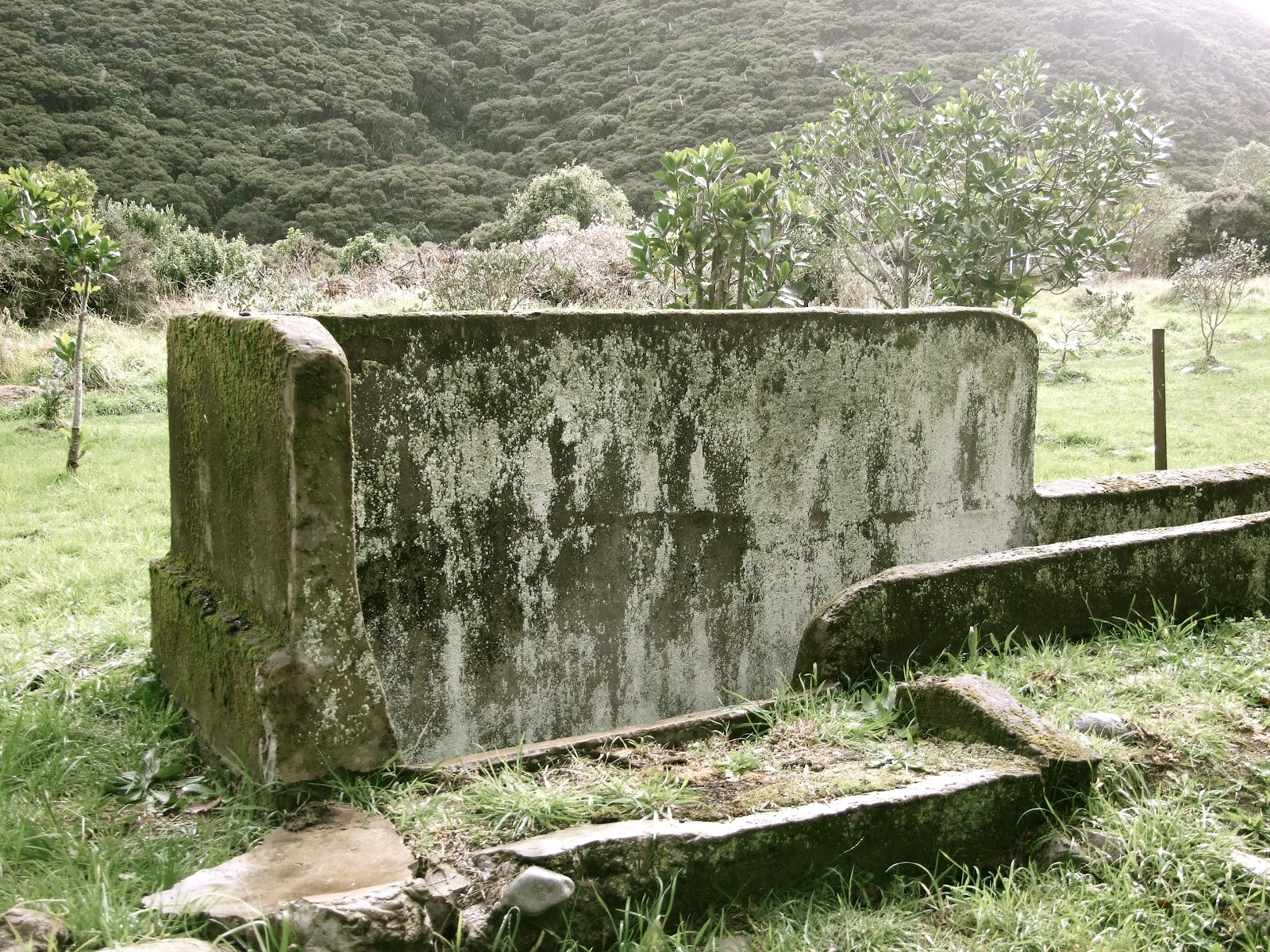


there is something compellingly beautiful about the curves and pits of weathered concrete, especially at the point at which it begins to look like stone. here is a sheep dip being swallowed up by weeds, lichen and moss on private land at the North end, its edge-zone liminality becoming even more borderland as the bush creeps in around it, as a structure it seems the most highly representative of the loss of the ability for farming to happen on the island, and the re-thinking of this as a revenue-making exercise for the island's residents towards more ostensibly sustainable ways of commodifying the land. the re-photographed photograph is of the same site (there is no trace of the fences), and located on the wall of the house directly adjacent to the sheep dip, belonging to direct descendents of the farmers in question, some of which i interviewed about their memories of this history.
erased kapiti #2 : a vernacular archaeology of waiorua valley


- Guy Debórd, 'Theory of the Dérive'
d.o.c hut silences

date : 27.05.2012
location : kiwi hut, near okupe lagoon, waiorua
time :
date : 29.05.2012
location : kiwi caravan, top of the ridge, rangatira
time :
notes : recordings of the silences inside outer-lying NZ dept. of Conservation huts on Kapiti Island. this network of humble buildings must surely include some of the more isolated and hidden of New Zealand's domestic spaces. inhabited in sparse manner by a regular flow of working scientists and trappers on parts of Kapiti island inaccessible to the public, sometimes only reachable via precarious and difficult tracks, each hut holds a kind of silence specific to its location : dripping water, creaking manuka branches, the blast of icy wind over the cliffs, the distant, piercing night calls of forest birds. seemingly devoid of overt personalisation, a glance inside their visitors' books reveals the wry story of the isolated and difficult work that goes on within them.

Te Kōkī : the dawn chorus
17 January 1770
17. This morn I was awakd by the singing of the birds ashore from whence we are distant not a quarter of a mile, the numbers of them were certainly very great who seemd to strain their throats with emulation perhaps; their voices were certainly the most melodious wild musick I have ever heard, almost imitating small bells but with the most tuneable silver sound imaginable to which maybe the distance was no small addition. On enquiring of our people I was told that they had observd them ever since we have been here, and that they begin to sing at about 1 or 2 in the morn and continue till sunrise, after which they are silent all day like our nightingales.
.---- --... .-.-.- / - .... .. ... / -- --- .-. -. / .. / .-- .- ... / .- .-- .- -.- -.. / -... -.-- / - .... . / ... .. -. --. .. -. --. / --- ..-. / - .... . / -... .. .-. -.. ... / .- ... .... --- .-. . / ..-. .-. --- -- / .-- .... . -. -.-. . / .-- . / .- .-. . / -.. .. ... - .- -. - / -. --- - / .- / --.- ..- .- .-. - . .-. / --- ..-. / .- / -- .. .-.. . --..-- / - .... . / -. ..- -- -... . .-. ... / --- ..-. / - .... . -- / .-- . .-. . / -.-. . .-. - .- .. -. .-.. -.-- / ...- . .-. -.-- / --. .-. . .- - / .-- .... --- / ... . . -- -.. / - --- / ... - .-. .- .. -. / - .... . .. .-. / - .... .-. --- .- - ... / .-- .. - .... / . -- ..- .-.. .- - .. --- -. / .--. . .-. .... .- .--. ... ? / - .... . .. .-. / ...- --- .. -.-. . ... / .-- . .-. . / -.-. . .-. - .- .. -. .-.. -.-- / - .... . / -- --- ... - / -- . .-.. --- -.. .. --- ..- ... / .-- .. .-.. -.. / -- ..- ... .. -.-. -.- / .. / .... .- ...- . / . ...- . .-. / .... . .- .-. -.. --..-- / .- .-.. -- --- ... - / .. -- .. - .- - .. -. --. / ... -- .- .-.. .-.. / -... . .-.. .-.. ... / -... ..- - / .-- .. - .... / - .... . / -- --- ... - / - ..- -. . .- -... .-.. . / ... .. .-.. ...- . .-. / ... --- ..- -. -.. / .. -- .- --. .. -. .- -... .-.. . / - --- / .-- .... .. -.-. .... / -- .- -.-- -... . / - .... . / -.. .. ... - .- -. -.-. . / .-- .- ... / -. --- / ... -- .- .-.. .-.. / .- -.. -.. .. - .. --- -. .-.-.- / --- -. / . -. --.- ..- .. .-. .. -. --. / --- ..-. / --- ..- .-. / .--. . --- .--. .-.. . / .. / .-- .- ... / - --- .-.. -.. / - .... .- - / - .... . -.-- / .... .- -.. / --- -... ... . .-. ...- -.. / - .... . -- / . ...- . .-. / ... .. -. -.-. . / .-- . / .... .- ...- . / -... . . -. / .... . .-. . --..-- / .- -. -.. / - .... .- - / - .... . -.-- / -... . --. .. -. / - --- / ... .. -. --. / .- - / .- -... --- ..- - / .---- / --- .-. / ..--- / .. -. / - .... . / -- --- .-. -. / .- -. -.. / -.-. --- -. - .. -. ..- . / - .. .-.. .-.. / ... ..- -. .-. .. ... . --..-- / .- ..-. - . .-. / .-- .... .. -.-. .... / - .... . -.-- / .- .-. . / ... .. .-.. . -. - / .- .-.. .-.. / -.. .- -.-- / .-.. .. -.- . / --- ..- .-. / -. .. --. .... - .. -. --. .- .-.. . ... .-.-.-
To Māori the birds are te reo o Tane, the voice of the God of the Forest and from whom many instruments are also fashioned. Traditionally, Maori musicians listened daily to te kōkī, drawing inspiration from its cadences, melodies, harmonies and rhythms.
17. This morn I was awakd by the singing of the birds ashore from whence we are distant not a quarter of a mile, the numbers of them were certainly very great who seemd to strain their throats with emulation perhaps; their voices were certainly the most melodious wild musick I have ever heard, almost imitating small bells but with the most tuneable silver sound imaginable to which maybe the distance was no small addition. On enquiring of our people I was told that they had observd them ever since we have been here, and that they begin to sing at about 1 or 2 in the morn and continue till sunrise, after which they are silent all day like our nightingales.
.---- --... .-.-.- / - .... .. ... / -- --- .-. -. / .. / .-- .- ... / .- .-- .- -.- -.. / -... -.-- / - .... . / ... .. -. --. .. -. --. / --- ..-. / - .... . / -... .. .-. -.. ... / .- ... .... --- .-. . / ..-. .-. --- -- / .-- .... . -. -.-. . / .-- . / .- .-. . / -.. .. ... - .- -. - / -. --- - / .- / --.- ..- .- .-. - . .-. / --- ..-. / .- / -- .. .-.. . --..-- / - .... . / -. ..- -- -... . .-. ... / --- ..-. / - .... . -- / .-- . .-. . / -.-. . .-. - .- .. -. .-.. -.-- / ...- . .-. -.-- / --. .-. . .- - / .-- .... --- / ... . . -- -.. / - --- / ... - .-. .- .. -. / - .... . .. .-. / - .... .-. --- .- - ... / .-- .. - .... / . -- ..- .-.. .- - .. --- -. / .--. . .-. .... .- .--. ... ? / - .... . .. .-. / ...- --- .. -.-. . ... / .-- . .-. . / -.-. . .-. - .- .. -. .-.. -.-- / - .... . / -- --- ... - / -- . .-.. --- -.. .. --- ..- ... / .-- .. .-.. -.. / -- ..- ... .. -.-. -.- / .. / .... .- ...- . / . ...- . .-. / .... . .- .-. -.. --..-- / .- .-.. -- --- ... - / .. -- .. - .- - .. -. --. / ... -- .- .-.. .-.. / -... . .-.. .-.. ... / -... ..- - / .-- .. - .... / - .... . / -- --- ... - / - ..- -. . .- -... .-.. . / ... .. .-.. ...- . .-. / ... --- ..- -. -.. / .. -- .- --. .. -. .- -... .-.. . / - --- / .-- .... .. -.-. .... / -- .- -.-- -... . / - .... . / -.. .. ... - .- -. -.-. . / .-- .- ... / -. --- / ... -- .- .-.. .-.. / .- -.. -.. .. - .. --- -. .-.-.- / --- -. / . -. --.- ..- .. .-. .. -. --. / --- ..-. / --- ..- .-. / .--. . --- .--. .-.. . / .. / .-- .- ... / - --- .-.. -.. / - .... .- - / - .... . -.-- / .... .- -.. / --- -... ... . .-. ...- -.. / - .... . -- / . ...- . .-. / ... .. -. -.-. . / .-- . / .... .- ...- . / -... . . -. / .... . .-. . --..-- / .- -. -.. / - .... .- - / - .... . -.-- / -... . --. .. -. / - --- / ... .. -. --. / .- - / .- -... --- ..- - / .---- / --- .-. / ..--- / .. -. / - .... . / -- --- .-. -. / .- -. -.. / -.-. --- -. - .. -. ..- . / - .. .-.. .-.. / ... ..- -. .-. .. ... . --..-- / .- ..-. - . .-. / .-- .... .. -.-. .... / - .... . -.-- / .- .-. . / ... .. .-.. . -. - / .- .-.. .-.. / -.. .- -.-- / .-.. .. -.- . / --- ..- .-. / -. .. --. .... - .. -. --. .- .-.. . ... .-.-.-
To Māori the birds are te reo o Tane, the voice of the God of the Forest and from whom many instruments are also fashioned. Traditionally, Maori musicians listened daily to te kōkī, drawing inspiration from its cadences, melodies, harmonies and rhythms.
it's cold outside

date : 30.03.2012
time : 11:15am
location : kitchen, the lodge, Waiorua bay
notes : the full and part time residents at Waiorua bay have connected their isolation to the mainland in a variety of ways over the decades, from a system of mirror signals on the beach, to cellphone networks, but the 20th century's keen reliance on the intimate aural domestica of radio transmission seems to be persevering healthily into the 21st. walking into the kitchen one could often find the chef, Lindsey, working to a backing soundtrack of National radio. one particular, slightly chilly morning I even caught him whistling along to the Victor Dimisch Band. now, if it'd been a tui whistling along to this song, that would really have been something. but Lindsey's tuneful efforts will have to do.
waiorua beehives

date : 30.03.2012
time : 12.30pm
location : beehives, Waiorua valley, Kapiti Island
notes : a keen photographer in the Kapiti Whanau has been dedicatedly out shooting bees all morning with his macro lens, and, while being evidently somewhat disappointed in the results, is interested in my enthusiasm around a binaural aural equivalent. he is explaining that in the middle of the day it is too hot for the hives, and the bees come out to cool down in the air, lazily swarming on the structures and buzzing in the syrupy air. heading to the hives the next day i also have in mind his advice that if you don't show fear the bees will not attack, and sit among the swarms with my eyes closed.
a hailstorm on the ridgeline

date : 29.5.2012
time : 12.15pm
location : top of the ridgeline, between stoat tracks 20 and 40, Kapiti Island
notes : hiking upwards from the east toward the western cliffs, we reach the top of the ridgeline slightly north of the Tuteremoana summit, where the steepness of the upslope levels out to meet the breathtakingly sharp drop of the cliffs falling vertically toward the sea. here we find a small, rolling grassy flat where, according to my laconic perveyor of local knowledge, takahe ("tarks") are often found grazing. without warning, a sudden hailstorm and icy southerly blast hits, crisping the knives of the grassblades and freshening the land, then just as suddenly leaves again.
a requiem.

location : war memorial stone seat, lower trig track, rangatira.
time : 4.00pm
duration : 45.23
notes : collaborative transmission work involving various field recordings collected in the month of may between 19.05.2012 and 30.05.2012 while sitting on war memorial bench sited on the trig track, Rangatira. these sent on 30.05.2012 to british based violinist Sarah Claman, whose response to the recordings in the form of notational transcriptions of birdsong and other environmental noise was then re-transmitted at the site, alongside the original location recordings, at approximately the same hour of the day these latter were collected.

Sarah says of her interpretation of the recordings :
"A quick explanation of how I approached this - I started by sitting and listening to the recordings from the memorial bench that you passed me and essentially scribbled on some manuscript paper that I had (using my violin to confirm the pitches of the bird calls). I wrote down some notes - some just a pitch, some with an articulation (for instance long, short, slurred etc) and also some strokes on the staves indicating the general shape of the phrase (including a long line of dots for a crazy bird that just wouldn't stop!!) I also wrote down some words and onomatopoeic aids (i.e ha! hooo! hoooooaww!). Then, I took my scrappy manuscript paper and played something of what I'd written down - using it as an aid for improvisation."
apart from its immediately-sited widening of the gap between a recording and its playback via instrumental interpretation, and the seemingly bathetic notion of birds playing memorial tunes for dead airmen being a pointer toward how endemic birdsong might have entered narratives of wartime nationalism, this transmission also makes reference to an historic event recorded 70 years ago this month, on 19.05.1942, by the BBC in the former residence of british cellist Beatrice Harrison, whose duet with Nightingales in her surrey garden on 19.5.1924 is regarded as the first live broadcast ever initiated from an outdoor location: "Each May 19th, the BBC returned to the garden to broadcast the nightingales, even after Beatrice moved house in 1936. On May 19th, 1942, as BBC engineers were recording the bird-song prior to transmission, a faint hum gradually became audible, slowly increasing in volume, as 197 bombers flew overhead on their way to raids in Mannheim. Realising the security risk, the broadcast was halted. But not the recording…"
---
*note this transmission's inclusion of the inevitable infiltration into all durational field recordings of the constant sound of commercial sightseeing plane flights overhead, one of the few 'non-natural' sounds which can be heard with regularity on Kapiti Island.
an act to restrict (1897, No. 28.)

date : 30.5.2012
location : kitchen, historic whare, rangatira
time : 9.30am
duration : 45:35
notes : transmission of morse code translation of Act 28. (1897) ('an act to restrict certain Dealings in the Island of Kapiti pending the Acquisition thereof by Her Majesty as a Public Reserve.') to in-situ radio receiver in public kitchen / dining / meeting space of Dept. of Conservation historic whare at Rangatira, the oldest building on the island and the earliest surviving structure associated with conservation in New Zealand, built in the 1860s. it has been home to caretakers since the early 1900s (beginning with early conservationist Richard Henry for three years (1908-11) after his pioneering of the translocation of flightless birds on Resolution Island (1894-1908) had led to subsequent disillusion upon finding mustelids could reach that sanctuary, rendering his 14 years of work transporting the birds useless) and despite its historic status is currently still an everyday base to scientists, trappers and researchers, often working alone for long stretches of time. creature comforts are few, but one constant of life are the national radio news reports from the radio/stereo in the kitchen, a malfunctioning, donated technological remnant from the 1980s, jokingly said to be 'haunted' due to its intermittent bursts of odd noises and habit of turning itself off or to 'tape jukebox' mode in the middle of a broadcast. this transmission re-situated the document which led to the creation of the sanctuary, via the acquisition by the crown of most of Kapiti island from its Iwi owners in the late 19th Century, into the current everyday life of the whare, in an era in which the Dept. of Conservation's crucial advocacy role for the environment is being challenged by Governmental funding cuts, ongoing detrimental job losses with associated loss of institutional memory for particular sites, and a forced shift of focus toward development of strategies for private fundraising, donations, and more volunteer staff.
volume : 0.01
pitch / Hz : 640
speed / wpm : 25
farnsworth speed / wpm : 20
---
.---- ---.. ----. --... --..-- / -. --- .-.-.- / ..--- ---.. .-.-.- / - .. - .-.. . .-.-.- .- -. / .- -.-. - / - --- / .-. . ... - .-. .. -.-. - / -.-. . .-. - .- .. -. / -.. . .- .-.. .. -. --. ... / .. -. / - .... . / .. ... .-.. .- -. -.. / --- ..-. / -.- .- .--. .. - .. / .--. . -. -.. .. -. --. / - .... . / .- -.-. --.- ..- .. ... .. - .. --- -. / - .... . .-. . --- ..-. / -... -.-- / .... . .-. / -- .- .--- . ... - -.-- / .- ... / .- / .--. ..- -... .-.. .. -.-. / .-. . ... . .-. ...- . .-.-.- / ? ..--- ..--- -. -.. / -.. . -.-. . -- -... . .-. --..-- / .---- ---.. ----. --... .-.-.- / .--. .-. . .- -- -... .-.. . .-.-.- .-- .... . .-. . .- ... / - .... . / .. ... .-.. .- -. -.. / --- ..-. / -.- .- .--. .. - .. --..-- / ... .. - ..- .- - . -.. / .. -. / - .... . / .-.. .- -. -.. / -.. .. ... - .-. .. -.-. - / --- ..-. / .-- . .-.. .-.. .. -. --. - --- -. --..-- / -.-. --- -. - .- .. -. .. -. --. / ..-. --- ..- .-. / - .... --- ..- ... .- -. -.. / -. .. -. . / .... ..- -. -.. .-. . -.. / .- -. -.. / -. .. -. . - -.-- / .- -.-. .-. . ... --..-- / -- --- .-. . / --- .-. / .-.. . ... ... --..-- / .. ... / --- .-- -. . -.. / .--. .-. .. -. -.-. .. .--. .- .-.. .-.. -.-- / -... -.-- / -. .- - .. ...- . ... / .-- .... --- / .- .-. . / -. --- - / .. -. / -... . -. . ..-. .. -.-. .. .- .-.. / ..- ... . / --- .-. / --- -.-. -.-. ..- .--. .- - .. --- -. / --- ..-. / - .... . / ... .- -- . ---... / .- -. -.. / .-- .... . .-. . .- ... --..-- / ..-. --- .-. / - .... . / .--. ..- .-. .--. --- ... . ... / --- ..-. / -.-. --- -. ... . .-. ...- .. -. --. / - .... . / -. .- - ..- .-. .- .-.. / ... -.-. . -. . .-. -.-- / --- ..-. / - .... . / ... .- .. -.. / .. ... .-.. .- -. -.. --..-- / .- -. -.. / .--. .-. --- ...- .. -.. .. -. --. / .- / .--. .-. . ... . .-. ...- . / ..-. --- .-. / - .... . / ..-. .- ..- -. .- / .- -. -.. / ..-. .-.. --- .-. .- / --- ..-. / -. . .-- / --.. . .- .-.. .- -. -.. --..-- / .. - / .. ... / -.. . ... .. .-. .- -... .-.. . / - .... .- - / - .... . / ... .- .. -.. / .. ... .-.. .- -. -.. / ... .... --- ..- .-.. -.. / -... . / .- -.-. --.- ..- .. .-. . -.. / -... -.-- / .... . .-. / -- .- .--- . ... - -.-- / .- ... / .- / .--. ..- -... .-.. .. -.-. / .-. . ... . .-. ...- . --..-- / .- -. -.. / - .... .- - / .--. . -. -.. .. -. --. / ... ..- -.-. .... / .- -.-. --.- ..- .. ... .. - .. --- -. / .- .-.. .-.. / -.. . .- .-.. .. -. --. ... / - .... . .-. . .-- .. - .... / -... -.-- / .--. .-. .. ...- .- - . / .--. . .-. ... --- -. ... / ... .... --- ..- .-.. -.. / -... . / .--. .-. --- .... .. -... .. - . -.. / .- -. -.. / -.. . - . .-. -- .. -. . -.. ---... / -... . / .. - / - .... . .-. . ..-. --- .-. . / . -. .- -.-. - . -.. / -... -.-- / - .... . / --. . -. . .-. .- .-.. / .- ... ... . -- -... .-.. -.-- / --- ..-. / -. . .-- / --.. . .- .-.. .- -. -.. / .. -. / .--. .- .-. .-.. .. .- -- . -. - / .- ... ... . -- -... .-.. . -.. --..-- / .- -. -.. / -... -.-- / - .... . / .- ..- - .... --- .-. .. - -.-- / --- ..-. / - .... . / ... .- -- . --..-- / .- ... / ..-. --- .-.. .-.. --- .-- ... ---... ? / .---- .-.-.- / ... .... --- .-. - / - .. - .-.. . .-.-.- / - .... . / ... .... --- .-. - / - .. - .-.. . / --- ..-. / - .... .. ... / .- -.-. - / .. ... / .-..-. - .... . / -.- .- .--. .. - .. / .. ... .-.. .- -. -.. / .--. ..- -... .-.. .. -.-. / .-. . ... . .-. ...- . / .- -.-. - --..-- / .---- ---.. ----. --... .-.-.- .-..-. / ..--- .-.-.- / -.. . .- .-.. .. -. --. ... / .-- .. - .... / .- -. -.-- / .. -. - . .-. . ... - ... / .. -. / - .... . / .. ... .-.. .- -. -.. / --- ..-. / -.- .- .--. .. - .. / .--. .-. --- .... .. -... .. - . -.. .-.-.- / ..-. .-. --- -- / .- -. -.. / .- ..-. - . .-. / - .... . / -.. .- - . / --- ..-. / - .... . / .--. .- ... ... .. -. --. / --- ..-. / - .... .. ... / .- -.-. - / .. - / ... .... .- .-.. .-.. / -. --- - / -... . / .-.. .- .-- ..-. ..- .-.. / ..-. --- .-. / .- -. -.-- / .--. . .-. ... --- -. / --- - .... . .-. / - .... .- -. / .- / .--. . .-. ... --- -. / .- -.-. - .. -. --. / ..-. --- .-. / --- .-. / --- -. / -... . .... .- .-.. ..-. / --- ..-. / - .... . / -.-. .-. --- .-- -. --..-- / .- -. -.. / ..- -. -.. . .-. / - .... . / .-- .-. .. - - . -. / .- ..- - .... --- .-. .. - -.-- / --- ..-. / .- / -- .. -. .. ... - . .-. / --- ..-. / - .... . / -.-. .-. --- .-- -. --..-- / - --- / .- -.-. --.- ..- .. .-. . / .- -. -.-- / . ... - .- - . / --- .-. / .. -. - . .-. . ... - / .. -. / .- -. -.-- / .-.. .- -. -.. ... / ..-. --- .-. -- .. -. --. / .--. .- .-. - / --- ..-. / - .... . / .. ... .-.. .- -. -.. / --- ..-. / -.- .- .--. .. - .. --..-- / .- ... / -.. . ... -.-. .-. .. -... . -.. / .. -. / - .... . / ... -.-. .... . -.. ..- .-.. . / .... . .-. . - --- --..-- / .-- .... . - .... . .-. / ... ..- -.-. .... / -.. . .- .-.. .. -. --. / -... . / .. -. / - .... . / -. .- - ..- .-. . / --- ..-. / .- -. / --- .-. .. --. .. -. .- .-.. / - .-. .- -. ... .- -.-. - .. --- -. --..-- / --- .-. / .. -. / -.-. --- -- .--. .-.. . - .. --- -. / --- ..-. / .- -. -.-- / - .-. .- -. ... .- -.-. - .. --- -. / --- .-. / -.. . .- .-.. .. -. --. / .. -. .. - .. .- - . -.. / --- .-. / -.-. --- -- -- . -. -.-. . -.. / .--. .-. .. --- .-. / - --- / - .... . / .--. .- ... ... .. -. --. / --- ..-. / - .... .. ... / .- -.-. - .-.-.- / ...-- .-.-.- / -.-. . .-. - .- .. -. / . ... - .- - . ... / .- -. -.. / .. -. - . .-. . ... - ... / .. -. / ... .- .. -.. / .. ... .-.. .- -. -.. / - --- / ...- . ... - / .. -. / .- .-.. .-.. / . ... - .- - . ... / .- -. -.. / .. -. - . .-. . ... - ... --..-- / .-- .... . - .... . .-. / ..-. .-. . . .... --- .-.. -.. / --- .-. / .-.. . ... ... . .-. / . ... - .- - . --..-- / .. -. / .- -. -.-- / .-.. .- -. -.. ... / ..-. --- .-. -- .. -. --. / .--. .- .-. - / --- ..-. / - .... . / ... .- .. -.. / .. ... .-.. .- -. -.. --..-- / .... . .-.. -.. / --- .-. / .- -.-. --.- ..- .. .-. . -.. / -... -.-- / .--. .- --. . / ..--- .- -. -.-- / .--. . .-. ... --- -. / --- .-. / .--. . .-. ... --- -. ... / --- - .... . .-. / - .... .- -. / - .... . / --- .-. .. --. .. -. .- .-.. / -. .- - .. ...- . / --- .-- -. . .-. ... --..-- / --- .-. / - .... . .. .-. / .... . .. .-. ... / --- .-. / ... ..- -.-. -.-. . ... ... --- .-. ... / .- -.-. -.-. --- .-. -.. .. -. --. / - --- / -. .- - .. ...- . / -.-. ..- ... - --- -- --..-- / ... .... .- .-.. .-.. / ..- .--. --- -. / - .... . / .--. .- ... ... .. -. --. / --- ..-. / - .... .. ... / .- -.-. - / ...- . ... - / .. -. / .... . .-. / -- .- .--- . ... - -.-- / ..- .--. --- -. / .- -. -.. / ... ..- -... .--- . -.-. - / - --- / ... ..- -.-. .... / - . .-. -- ... / .- ... / - --- / -.-. --- -- .--. . -. ... .- - .. --- -. / .- -. -.. / --- - .... . .-. .-- .. ... . / .- ... / -... -.-- / - .... .. ... / .- -.-. - / .- .-. . / .--. .-. --- ...- .. -.. . -.. .-.-.- / ....- .-.-.- / .--. .-. --- ...- .. ... .. --- -. / ..-. --- .-. / .--. .- -.-- -- . -. - / --- ..-. / -.-. --- -- .--. . -. ... .- - .. --- -. / - --- / --- .-- -. . .-. ... / --- .-. / .-.. . ... ... . . ... .-.-.- / ..-. .- .. .-.. .. -. --. / .- -. -.-- / .- --. .-. . . -- . -. - / -... . .. -. --. / -- .- -.. . / .- ... / - --- / -.-. --- -- .--. . -. ... .- - .. --- -. / - --- / -... . / .--. .- .. -.. --..-- / . ...- . .-. -.-- / .--. . .-. ... --- -. / -.. . .--. .-. .. ...- . -.. / --- ..-. / .- -. -.-- / ..-. .-. . . .... --- .-.. -.. / --- .-. / .- -. -.-- / .-.. . ... ... . .-. / ...- .- .-.. .. -.. / . ... - .- - . / --- .-. / .. -. - . .-. . ... - / -... -.-- / - .... . / --- .--. . .-. .- - .. --- -. / --- ..-. / - .... .. ... / .- -.-. - / ... .... .- .-.. .-.. / -... . / . -. - .. - .-.. . -.. / - --- / -.-. --- -- .--. . -. ... .- - .. --- -. / - .... . .-. . ..-. --- .-. --..-- / - --- / -... . / .- ... -.-. . .-. - .- .. -. . -.. / .- -. -.. / -.. . - . .-. -- .. -. . -.. / ..- -. -.. . .-. / - .... . / .--. .-. --- ...- .. ... .. --- -. ... / --- ..-. / .-..-. - .... . / .--. ..- -... .-.. .. -.-. / .-- --- .-. -.- ... / .- -.-. - --..-- / .---- ---.. ----. ....- --..-- .-..-. / .- ... / .. -. / - .... . / -.-. .- ... . / --- ..-. / -. .- - .. ...- . / .-.. .- -. -.. ... / --- .-. / --- - .... . .-. / .-.. .- -. -.. ... --..-- / .- ... / - .... . / -.-. .- ... . / -- .- -.-- / -... . --..-- / - .- -.- . -. / ..-. --- .-. / .- / .--. ..- -... .-.. .. -.-. / .-- --- .-. -.- .-.-.- / ..... .-.-.- / -.. . . -.. ... / --- .-. / .. -. ... - .-. ..- -- . -. - ... / --- ..-. / - .. - .-.. . / - --- / -... . / .-. . --. .. ... - . .-. . -.. / --- .-. / -.. . .--. --- ... .. - . -.. .-.-.- / .- .-.. .-.. / .--. . .-. ... --- -. ... / -.-. .-.. .- .. -- .. -. --. / - --- / .... .- ...- . / .... . .-. . - --- ..-. --- .-. . / .- -.-. --.- ..- .. .-. . -.. / .- -. -.-- / ...- .- .-.. .. -.. / . ... - .- - . / --- .-. / .. -. - . .-. . ... - / .. -. / - .... . / ... .- .. -.. / .-.. .- -. -.. ... / --- .-. / .- -. -.-- / .--. .- .-. - / - .... . .-. . --- ..-. / .- ... / . ...- .. -.. . -. -.-. . -.. / -... -.-- / .- -. -.-- / -.. . . -.. / --- .-. / .. -. ... - .-. ..- -- . -. - / ... .... .- .-.. .-.. / .-. . --. .. ... - . .-. / ... ..- -.-. .... / -.. . . -.. / --- .-. / .. -. ... - .-. ..- -- . -. - / .- - / - .... . / --- ..-. ..-. .. -.-. . / --- ..-. / - .... . / -.. .. ... - .-. .. -.-. - / .-.. .- -. -.. / .-. . --. .. ... - .-. .- .-. --..-- / .-- . .-.. .-.. .. -. --. - --- -. --..-- / .-- .. - .... .. -. / - .... .-. . . / -.-. .- .-.. . -. -.. .- .-. / -- --- -. - .... ... / ..-. .-. --- -- / - .... . / -.. .- - . / --- ..-. / - .... . / .--. .- ... ... .. -. --. / --- ..-. / - .... .. ... / .- -.-. - --..-- / --- .-. --..-- / .. ..-. / ... ..- -.-. .... / .-. . --. .. ... - .-. .- - .. --- -. / .. ... / -. --- - / .--. . .-. -- .. ... ... .. -... .-.. . / --- .-. / ..-. . .- ... .. -... .-.. . --..-- / - .... . -. / - .... . / -.. . . -.. / --- .-. / .. -. ... - .-. ..- -- . -. - / - --- --. . - .... . .-. / .-- .. - .... / .- / -.-. . .-. - .. ..-. .. . -.. / -.-. --- .--. -.-- / - .... . .-. . --- ..-. / ... .... .- .-.. .-.. / -... . / -.. . .--. --- ... .. - . -.. / .-- .. - .... / ... ..- -.-. .... / .-. . --. .. ... - .-. .- .-. / .-- .. - .... .. -. / - .... . / ... .- .. -.. / .--. . .-. .. --- -.. / --- ..-. / - .... .-. . . / -- --- -. - .... ... .-.-.- / -.... .-.-.- / .--. .-. --- --- ..-. / - .... . .-. . --- ..-. / - --- / -... . / --. .. ...- . -. .-.-.- / -. --- / -.-. .-.. .- .. -- / ..-. --- .-. / -.-. --- -- .--. . -. ... .- - .. --- -. / ... .... .- .-.. .-.. / -... . / . -. - . .-. - .- .. -. . -.. / ..- -. - .. .-.. / .--. .-. --- --- ..-. / --- ..-. / ... ..- -.-. .... / .-. . --. .. ... - .-. .- - .. --- -. / --- .-. / -.. . .--. --- ... .. - / -... . / --. .. ...- . -. .-.-.- / ... -.-. .... . -.. ..- .-.. . .-.-.- / -.- .- .--. .. - .. / .. ... .-.. .- -. -.. .-.-.- / ... -.-. .... . -.. ..- .-.. . .-.-.- / .- .-.. .-.. / - .... .- - / .--. .. . -.-. . / --- .-. / .--. .- .-. -.-. . .-.. / --- ..-. / .-.. .- -. -.. / -.- -. --- .-- -. / .- ... / - .... . / .. ... .-.. .- -. -.. / --- ..-. / -.- .- .--. .. - .. --..-- / .. -. / - .... . / -.- .- .--. .. - .. / ... ..- .-. ...- . -.-- / -.. .. ... - .-. .. -.-. - --..-- / .--. .-. --- ...- .. -. -.-. .. .- .-.. / -.. .. ... - .-. .. -.-. - / --- ..-. / .-- . .-.. .-.. .. -. --. - --- -. --..-- / .- -. -.. / -.-. --- -. - .- .. -. .. -. --. / .- -... --- ..- - / ....- --..-- ----. ----. ----- / .- -.-. .-. . ... --..-- / -- --- .-. . / --- .-. / .-.. . ... ... .-.-.- / -... --- ..- -. -.. . -.. / --- -. / - .... . / -. --- .-. - .... -....- . .- ... - --..-- / ... --- ..- - .... -....- . .- ... - --..-- / ... --- ..- - .... -....- .-- . ... - --..-- / .- -. -.. / -. --- .-. - .... -....- .-- . ... - / -... -.-- / -.-. --- --- -.- / ... - .-. .- .. - ---... / .- ... / - .... . / ... .- -- . / .. ... / -- --- .-. . / .--. .- .-. - .. -.-. ..- .-.. .- .-. .-.. -.-- / ... .... --- .-- -. / --- -. / - .... . / .--. .-.. .- -. / - .... . .-. . --- ..-. / -.. . .--. --- ... .. - . -.. / .. -. / - .... . / -.. .. ... - .-. .. -.-. - / ... ..- .-. ...- . -.-- / --- ..-. ..-. .. -.-. . --..-- / .-- . .-.. .-.. .. -. --. - --- -. .-.-.-
---
1897, No. 28. Title.An Act to restrict certain Dealings in the Island of Kapiti pending the Acquisition thereof by Her Majesty as a Public Reserve. [22nd December, 1897. Preamble.WHEREAS the Island of Kapiti, situated in the Land District of Wellington, containing four thousand nine hundred and ninety acres, more or less, is owned principally by Natives who are not in beneficial use or occupation of the same: And whereas, for the purposes of conserving the natural scenery of the said island, and providing a preserve for the fauna and flora of New Zealand, it is desirable that the said island should be acquired by Her Majesty as a public reserve, and that pending such acquisition all dealings therewith by private persons should be prohibited and determined: Be it therefore enacted by the General Assembly of New Zealand in Parliament assembled, and by the authority of the same, as follows:— 1. Short Title. The Short Title of this Act is "The Kapiti Island Public Reserve Act, 1897." 2. Dealings with any interests in the Island of Kapiti prohibited. From and after the date of the passing of this Act it shall not be lawful for any person other than a person acting for or on behalf of the Crown, and under the written authority of a Minister of the Crown, to acquire any estate or interest in any lands forming part of the Island of Kapiti, as described in the Schedule hereto, whether such dealing be in the nature of an original transaction, or in completion of any transaction or dealing initiated or commenced prior to the passing of this Act. 3. Certain estates and interests in said island to vest in All estates and interests, whether freehold or lesser estate, in any lands forming part of the said island, held or acquired by PAGE 2any person or persons other than the original Native owners, or their heirs or successors according to Native custom, shall upon the passing of this Act vest in Her Majesty upon and subject to such terms as to compensation and otherwise as by this Act are provided. 4. Provision for payment of compensation to owners or lessees. Failing any agreement being made as to compensation to be paid, every person deprived of any freehold or any lesser valid estate or interest by the operation of this Act shall be entitled to compensation therefor, to be ascertained and determined under the provisions of "The Public Works Act, 1894," as in the case of Native lands or other lands, as the case may be, taken for a public work. 5. Deeds or instruments of title to be registered or deposited. All persons claiming to have heretofore acquired any valid estate or interest in the said lands or any part thereof as evidenced by any deed or instrument shall register such deed or instrument at the office of the District Land Registrar, Wellington, within three calendar months from the date of the passing of this Act, or, if such registration is not permissible or feasible, then the deed or instrument together with a certified copy thereof shall be deposited with such Registrar within the said period of three months. 6. Proof thereof to be given. No claim for compensation shall be entertained until proof of such registration or deposit be given. SCHEDULE. Kapiti Island. Schedule. All that piece or parcel of land known as the Island of Kapiti, in the Kapiti Survey District, Provincial District of Wellington, and containing about 4,990 acres, more or less. Bounded on the north-east, south-east, south-west, and north-west by Cook Strait: as the same is more particularly shown on the plan thereof deposited in the District Survey Office, Wellington.
shipwreck tapes 2 (‘a corpse by the arm set apart from the secret it keeps’)

date : 27.5.2012
location : rangatira bay, E 1762921, N 5475591
time : 5.40pm
duration : -
notes : a locational sound piece for tape involving a reading of two texts written in the same year, 1897 : stephane mallarme's poem 'un coup de des' ('one toss of the dice never will abolish chance'), and the Kapiti Island Public Reserve Act, texts recorded onto a and b sides. cassette was then taken to the sea at rangatira and audio of reading overwritten with site recording, just on sundown, 27.5.2012. tape palimpsest immediately buried at the same spot on the shoreline. location finders : vertical marker of whalebone, GPS co-ordinates. tape successfully retrieved from site on the 1st June 2012.

---
"22nd December 1897. Preamble. WHEREAS the Island of Kapiti, situated in the Land District of Wellington, containing four thousand nine hundred and ninety acres, more or less, is owned principally by Natives who are not in beneficial use or occupation of the same: And whereas, for the purposes of conserving the natural scenery of the said island, and providing a preserve for the fauna and flora of New Zealand, it is desirable that the said island be acquired by Her Magesty as a public reserve, and that pending such acquisition all dealings therewith by private persons should be prohibited..."
---
the

---
"22nd December 1897. Preamble. WHEREAS the Island of Kapiti, situated in the Land District of Wellington, containing four thousand nine hundred and ninety acres, more or less, is owned principally by Natives who are not in beneficial use or occupation of the same: And whereas, for the purposes of conserving the natural scenery of the said island, and providing a preserve for the fauna and flora of New Zealand, it is desirable that the said island be acquired by Her Magesty as a public reserve, and that pending such acquisition all dealings therewith by private persons should be prohibited..."
---
the
Abyss
whitened
becalmedfuriousunder an inclination
glides desperatelywith wing
gull lines, at a slope of conduction (for waiorua shoreline, violin and shortwave)

date : 11.5.2012
location : shoreline, waiorua bay
time : 11.20pm
duration : 20:00
notes : walking along the coast of Waiorua bay, at the North end of Kapiti Island, I arrive at the site of a decommissioned coastal warning light tower whose few remnants - a lichen-encrusted concrete foundation and various planks scattered around the stones - are slowly biodegrading, becoming indistinguishable from the rocky beach and plentiful driftwood heaped in drifts metres high, in some places including whole trees, as the seasons of rain and sun take their toll. It seems the text of history is crumbling, its memory of human inhabitation falling away as the rapidly re-foresting island claims all traces, a complex palimpsest underneath its current identity as a place where New Zealand’s remaining birds can replenish their populations without pressure from introduced mammalian predators. Returning to the site over a few weeks, I make location recordings, I take a radio and search the shortwave, finding a paucity of signals registering in the aetheric sea, and just before midnight I play the violin in the freezing winds, folding the sounds of the instrument into the wider instrumentation of the place, its harsh tonalities, shrieking seabirds and the ongoing crash of the waves, the night calls of forest birds. It seems that sometime during this process the violin itself loses its memory, or perhaps regains it, becomes tidal and avian, full of a voice tuning into the site, in and out of signal. I imagine it is the sound of the site speaking to itself, but of course, it is my own unfamiliar voice that rings in my ears, my own listening that I am listening to.
---
gull lines, at a slope of conduction (for waiorua shoreline, violin and shortwave) was recorded as a contribution to the Time Inventors Kabinet (TIK) festival of ecological media arts (11 - 13 May 2012) in Brussels
radio d'oiseaux (kokako variations)

date : 21.5.2012
location : trig track, rangatira
time : 12.20 pm
duration : 30:00
notes : small, distributed in trees, in hollow logs and on the ground, a flock of radio receivers inhabits a forest area near a large native Rata tree on Kapiti, an island off the coast of the lower North Island of Aotearoa/New Zealand. Slowly, the radios enter the soundscape of the surrounding biosphere, chime in with birdsong captured in field recordings, gathered in the same area on previous days, making audible the signal from a small-radius mini FM transmitter. Down the mountain, a young male Kokako has been calling for the last three months, unsuccessfully trying to attract a mate. The main thing he has been able to attract are the attentions of other, more common endemic forest birds, Tui and Bellbirds, who, being skilled mimics, have started to imitate his calls. Perhaps in response to such unwanted attentions, he has not been heard for the past week, but the radio remembers him, playing back his song in an evocation of both the long history of human vocalisation of birds in this place, and the birds’ own complex mimicry of each other. Rarely heard but even more rarely seen in the wild, the Kokako, a shy inhabitant of deep forest, and one of New Zealand’s most endangered birds, whose calls have been described variously as “flute-like, organ-like, bell like, sweet, plaintive, haunting and ventriloquial”, has lived on this island since 1991, when thirty three birds were transferred from three remnant populations elsewhere in the North Island. These populations, artificially lodged together into a new environment, yet all sourced from different localities and having their own dialects, originally didn’t recognise each other as the same species, and so breeding was, understandably, unsuccessful. In the ensuing decades, it seems, the development of a ‘Kapiti dialect’ has emerged on the island, and the birds have begun to converse, and to breed, and become tentatively established locally. The South Island subspecies of the Kokako has been declared extinct, and until recently the North Island variant was declining toward the same fate, but in the last few years, due to such placement on offshore predator-free islands, the birds have become one of the recent success stories of New Zealand conservation species management. A document of a single take performance with no human listeners, beginning and ending as an unadulterated recording of the sounds of the locale in which it was enacted, this mini FM transmission subtly weaves various other recordings from the same location at other times of day into the extant soundscape, a collected sound library begun with the very early morning chorus and progressing toward midday, the time when the piece was transmitted. Shifting sound tonalities are heard, these are entirely due to the aforementioned ‘flock’ of radios and how they are positioned in relation to the stereo microphones used to record the piece. Static is heard when the radios leave this radius of transmission, the territory of the signal marking its place in the forest with song, shards of noise signifying its breach, echoing its placement on an island in a biosecure, highly managed environment forever on the lookout for tears in the fabric, and also birdsong itself as a highly territorialised marker of location and identity. The chiming dawn chorus of bellbirds at the piece’s apex thins out to eventually become a duet of call and response in real time between a live Kokako, attracted by the transmission, and the radios switching off and on as they transmit the song of the same bird, a disjunctive ventriloquistic mediated discourse, not without its own poetry, bird and radio calling to each other for an extended moment over the thick native tree wooded valley. radio d'oiseaux (kokako variations), through its fabric of forgetting and remembering, of dialect and localisation, ponders the hope for an environmentally aware media that doesn't approach environment from the perspective of the covetous collector or become a mere one-way conduit for the human ear, but leaves the sounds where they are, taking the advice of the New Zealand environmental care code: Toitu te whenua (leave the land undisturbed), at the same time risking an indulgence of the radio’s secret fantasies of interspecies communication, of not only being a sender but also a receiver, of joining in with the chorus and listening to its localised specificity, of being part of the living soundscape rather than merely part of its museum.
---
this programme was played around the radia network as show #374, series 28, running from 28.5.12 - 3.6.12. radio one, dunedin, previewed it a week earlier, while i was still on the island, airing the show on 27.5.12.
a nest brimming with with its own locality (cuckoo transmission)

date: 08.05.2012
location: waiorua valley
time: 3.15pm
duration: 20mins
notes: a thin line of radio noise weaves through the spatialities of the birdsong in the surrounding bush and the transmission of birdsong recorded two days earlier in the same spot. feedback from the microphones nestled too close together in the nest itself and surrounding radio feedback also complicate the playback process. signal and noise are both present. a saddleback sounds in the background of this passage, announcing its own territory. then the radios themselves alone after the audio playback has finished. at the conclusion of the piece the tape recorder is stopped, the tape pulled out of its cassette housing and wound up into a new housing - the nest. the mostly empty cassette shell is then tucked under the nest and the structure placed carefully back into the bush where it was initially found. The materiality of the tape becomes analogous to a new nesting material, which is itself an alien, non-endemic element in the bush, will be further documented as it sits in the bush for the duration of the residency. It will be removed from the island at the residency’s conclusion.
it is all I can do not to start attributing animistic properties to the tape recorder, nestled among my menagerie of radios it itself looks like a cuckoo.


Caleb Kelly discusses the residency and especially the work Folding a Coastline into a Shipwrecked Space, in a post on his blog, Futures from the Field: Hunting for Sound in Nature 6:
"In 2012 Sally Ann McIntyre, a New Zealand based artist who works predominantly with radio signals
and field recordings, spent six weeks on Kapiti Island, a coastal island in New Zealand. The island is a
wildlife sanctuary yet is not the typical nature recordists’ fare. On the island McIntyre found the ruins of
Māori settlement, the whaling industry, battles and deforestation. Instead of imagining the island as a
pristine sanctuary, ripe for the field recording of an innocent nature, McIntyre records the sounds she
actually finds there. She explains that while from a distance the island might look uninhabited, when on it
evidence for human inhabitation is prevalent: “Aeroplanes break the fiction of natural silence, salt-wind
weathered signs announce ‘no landing here’, giant reflectors on the hills warn those looking from the sea
of the protected marine reserve border, and the beach is strewn with ambiguous historic signs and
remnants delivered back to the land by the waves.”
While McIntyre still holds to the desire for pure non-manipulated field recordings (as evidenced by
recent releases on record labels who pronounce that the works are ‘unprocessed’), in fact she is clearly
open to processing the ‘natural sound’ pre-recording. On discovering a buoy on the coast McIntyre
placed a microphone inside and captured the resulting sounds from within. Industrial waste becomes a
filter through which listeners experience the sounds on Kapiti Island."
Dugal McKinnon writes lengthily on Collected Silences for Lord Rothschild and Huia Transcriptions, in his paper Dead Silence: ecological silencing and environmentally-engaged sound-art, for Leonardo Music Journal:
"For contemporary sound artists engaged with environmental matters in which silence plays a role, the
question is how to make dead silence speak? How to represent and deploy it meaningfully and in ways
that do not cloak it in the habits of silence associated with Cage and acoustic ecology? One of the most
problematic silences for both Cage and acoustic ecology is the substitution of recorded for live sound.
The fear here, following Baudrillard’s theory of simulation, is that the recording silences the living,
sounding thing. This perennial concern, encapsulated in Schafer’s concept of schizophonia as an aberrant
technological phenomenon, is old as recording technology itself. Contra this perspective however,
recording can be used to musicalize acoustic silence as the horizon of the audible, bringing it into dialogue
with Cageian silence and, as we will shortly hear, creating a powerful affective tool through which to
address ecological silencing.
The musicalisation of acoustic silence is made possible by the intentional act of recording which functions
as framing device for acoustic silence. This is a Cageian move: the giving of duration to something that is
without duration, just as 4’33” gives form to the silence of the place of listening thereby calling attention
to what is acoustically present there. If nothing is acoustically present, or if the thing being recorded
cannot be acoustically present, then recording -- and listening -- draws attention to the acoustic silence
of that thing. Such a move can be conceptual, as in Yoko Ono’s Tape Piece III or artist Julian Dashper’s
recordings of canonic art works of the 20th century. When the intention of the work is ecological
however, acoustic silence takes political form; the gap between the acoustic absence of silenced thing and
the Cageian silence we hear around it calls attention to the irrevocable loss inherent in that heterogeneous
silence. This is achieved in Sally McIntyre’s transmission arts piece, Collected Silences for Lord
Rothschild (2012), which replicates Dashper’s move but with an ethical-environmental dimension:
The schismogenesis of recording, a more productive conceptual cousin to Schafer’s schizophonia, also
plays a vital role in environmentally engaged sound art such as McIntyre’s. Schismogenesis, in Stephen
Feld’s use of the term (itself borrowed from Gregory Bateson), brings a new kind of sonic entity into
being, which reveals aspects of its live source but is not the same as this source. This is a useful word for
a familiar idea, much beloved by phonographists of all kinds: schismogenesis is what made possible the
soundscape analyses of the World Soundscape Project as well as the sonic discourse of Schaefferian
musique concrète. Yet the recording does not and cannot substitute for the absent source, despite the
presence of its acoustic trace."
"In 2012 Sally Ann McIntyre, a New Zealand based artist who works predominantly with radio signals
and field recordings, spent six weeks on Kapiti Island, a coastal island in New Zealand. The island is a
wildlife sanctuary yet is not the typical nature recordists’ fare. On the island McIntyre found the ruins of
Māori settlement, the whaling industry, battles and deforestation. Instead of imagining the island as a
pristine sanctuary, ripe for the field recording of an innocent nature, McIntyre records the sounds she
actually finds there. She explains that while from a distance the island might look uninhabited, when on it
evidence for human inhabitation is prevalent: “Aeroplanes break the fiction of natural silence, salt-wind
weathered signs announce ‘no landing here’, giant reflectors on the hills warn those looking from the sea
of the protected marine reserve border, and the beach is strewn with ambiguous historic signs and
remnants delivered back to the land by the waves.”
While McIntyre still holds to the desire for pure non-manipulated field recordings (as evidenced by
recent releases on record labels who pronounce that the works are ‘unprocessed’), in fact she is clearly
open to processing the ‘natural sound’ pre-recording. On discovering a buoy on the coast McIntyre
placed a microphone inside and captured the resulting sounds from within. Industrial waste becomes a
filter through which listeners experience the sounds on Kapiti Island."
Dugal McKinnon writes lengthily on Collected Silences for Lord Rothschild and Huia Transcriptions, in his paper Dead Silence: ecological silencing and environmentally-engaged sound-art, for Leonardo Music Journal:
"For contemporary sound artists engaged with environmental matters in which silence plays a role, the
question is how to make dead silence speak? How to represent and deploy it meaningfully and in ways
that do not cloak it in the habits of silence associated with Cage and acoustic ecology? One of the most
problematic silences for both Cage and acoustic ecology is the substitution of recorded for live sound.
The fear here, following Baudrillard’s theory of simulation, is that the recording silences the living,
sounding thing. This perennial concern, encapsulated in Schafer’s concept of schizophonia as an aberrant
technological phenomenon, is old as recording technology itself. Contra this perspective however,
recording can be used to musicalize acoustic silence as the horizon of the audible, bringing it into dialogue
with Cageian silence and, as we will shortly hear, creating a powerful affective tool through which to
address ecological silencing.
The musicalisation of acoustic silence is made possible by the intentional act of recording which functions
as framing device for acoustic silence. This is a Cageian move: the giving of duration to something that is
without duration, just as 4’33” gives form to the silence of the place of listening thereby calling attention
to what is acoustically present there. If nothing is acoustically present, or if the thing being recorded
cannot be acoustically present, then recording -- and listening -- draws attention to the acoustic silence
of that thing. Such a move can be conceptual, as in Yoko Ono’s Tape Piece III or artist Julian Dashper’s
recordings of canonic art works of the 20th century. When the intention of the work is ecological
however, acoustic silence takes political form; the gap between the acoustic absence of silenced thing and
the Cageian silence we hear around it calls attention to the irrevocable loss inherent in that heterogeneous
silence. This is achieved in Sally McIntyre’s transmission arts piece, Collected Silences for Lord
Rothschild (2012), which replicates Dashper’s move but with an ethical-environmental dimension:
"Recordings
of the mounted specimens of two species of endemic New Zealand birds, the Huia
(Heteralocha acutirostris), and the Laughing Owl or Whekau (Sceloglaux albifacies) held in the
collection of The Museum of New Zealand Te Papa Tongarewa. Both these species were driven to
extinction, partially through the actions of European collectors, in the early 1900s. They were both still
recorded as alive during the twentieth century's first blossoming, after the invention of recording
technology, but neither of their songs are on record."
(Heteralocha acutirostris), and the Laughing Owl or Whekau (Sceloglaux albifacies) held in the
collection of The Museum of New Zealand Te Papa Tongarewa. Both these species were driven to
extinction, partially through the actions of European collectors, in the early 1900s. They were both still
recorded as alive during the twentieth century's first blossoming, after the invention of recording
technology, but neither of their songs are on record."
Making dead silences speak may also be predicated
not on acoustic silence but, taking a conceptual
turn, by evoking the ecological silence of an extinct thing through sound. Another work by McIntyre,
Huia Transcriptions (2012), uses “transcriptions to music box of one of the few extant accounts of the
calls of Huia (Heteralocha acutirostris), as notated by a Mr. H. T. Caver in the late 1800s” which are
“played back in the early morning chorus into forest areas of Kapiti [Island, NZ], amplified
non-electronically on the trunks of species of trees Huia would likely have climbed”. What this allows us
to hear, negatively magnified through the audible presence of living birds, is the silence of the extinct Huia,
as the simple transcriptions and music box realisation of these fail, poetically and affectingly, to do
anything more than gracelessly approximate a call known only through musical and textual descriptions.
turn, by evoking the ecological silence of an extinct thing through sound. Another work by McIntyre,
Huia Transcriptions (2012), uses “transcriptions to music box of one of the few extant accounts of the
calls of Huia (Heteralocha acutirostris), as notated by a Mr. H. T. Caver in the late 1800s” which are
“played back in the early morning chorus into forest areas of Kapiti [Island, NZ], amplified
non-electronically on the trunks of species of trees Huia would likely have climbed”. What this allows us
to hear, negatively magnified through the audible presence of living birds, is the silence of the extinct Huia,
as the simple transcriptions and music box realisation of these fail, poetically and affectingly, to do
anything more than gracelessly approximate a call known only through musical and textual descriptions.
plays a vital role in environmentally engaged sound art such as McIntyre’s. Schismogenesis, in Stephen
Feld’s use of the term (itself borrowed from Gregory Bateson), brings a new kind of sonic entity into
being, which reveals aspects of its live source but is not the same as this source. This is a useful word for
a familiar idea, much beloved by phonographists of all kinds: schismogenesis is what made possible the
soundscape analyses of the World Soundscape Project as well as the sonic discourse of Schaefferian
musique concrète. Yet the recording does not and cannot substitute for the absent source, despite the
presence of its acoustic trace."
Subscribe to:
Posts (Atom)